

General


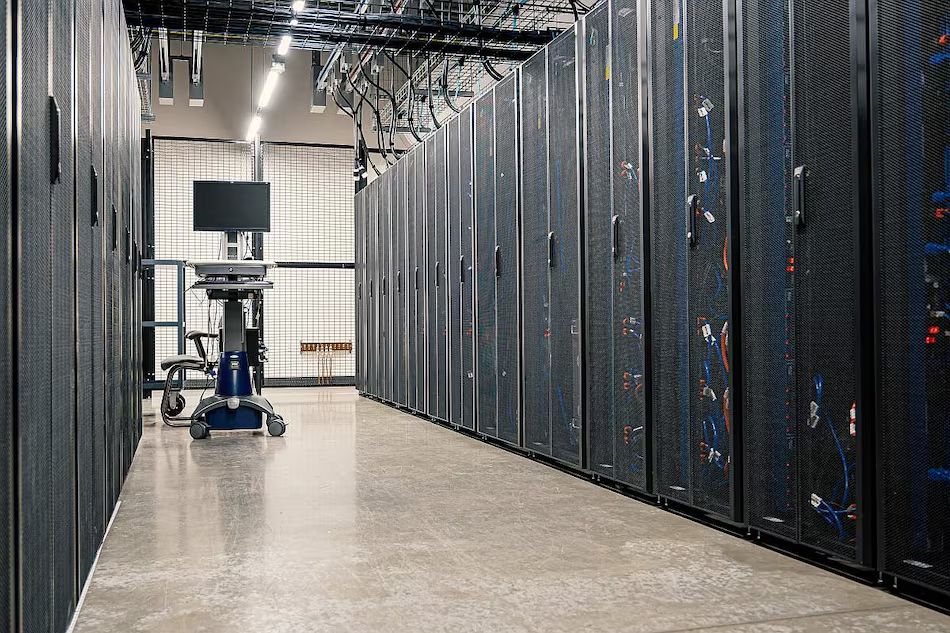
The Office of the Principal Scientific Adviser (PSA) to the Government of India has released a white paper titled “Democratising Access to AI Infrastructure”, outlining strategies to expand access to AI infrastructure across the country. Prepared with input from experts and stakeholders, the paper examines physical and digital AI infrastructure, current capacities in India and measures for broader, equitable access to computing power, datasets and model ecosystems.
The PSA emphasizes treating AI infrastructure as a shared national resource, enabling innovators to build local-language tools, assistive technologies and solutions for India's diverse needs. Democratising access involves making compute power, datasets and AI model toolchains widely available and affordable, rather than limiting them to urban hubs or global corporations. Physical infrastructure includes data centres, GPUs, TPUs, and other processors for training large AI models. India hosts nearly 20% of global data but only 3% of global data centre capacity, with most centres concentrated in Mumbai, Navi Mumbai, Chennai, Bengaluru, Hyderabad, Delhi NCR, Pune and Kolkata. The report also highlights the importance of high-quality datasets and foundational AI model ecosystems for innovation.
The vision centers on digital public infrastructure (DPI) treating AI systems as digital public goods, allowing stakeholders to access data, compute and models without physical proximity. The paper suggests a modular approach, starting with directories, metadata standards, access protocols and registries, eventually progressing to data access systems and coordinated compute mechanisms. While not proposing formal policy changes, the white paper provides a roadmap to shape India’s AI infrastructure early, ensuring scalable, equitable access for non-urban regions and individual stakeholders in the future.

















Comments (0)
No comments yet
Be the first to comment!