

Movies

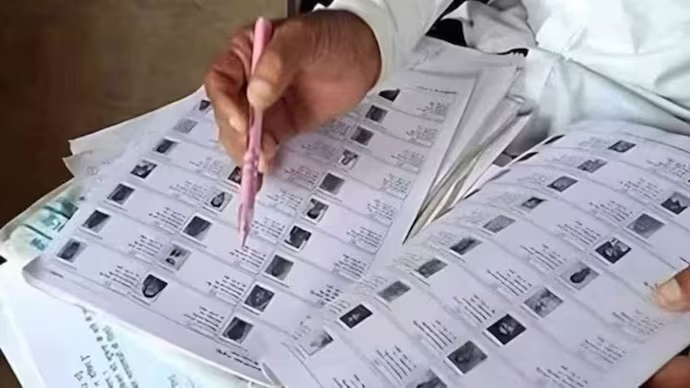
Despite objections and reports of irregularities, the Election Commission’s Special Intensive Revision (SIR) of electoral rolls has completed its third phase, aimed at preparing what it describes as a ‘clean’ voter list. In this phase, electoral rolls covering 36.73 crore voters across 16 states and three Union Territories were scrutinised, with the Election Commission stating that around 6 crore names were removed. While the third phase reportedly witnessed less opposition than the earlier stages, nearly 13 crore names have been removed across all three phases. However, deletion does not necessarily mean permanent loss of voting rights. Those affected may be able to get their names restored by filing objections and submitting documents sought by the Election Commission. For many ordinary citizens, however, arranging documents, visiting government offices and taking time away from work could prove difficult and costly.
In West Bengal, concerns have been raised over large numbers of voters being excluded from electoral rolls due to minor discrepancies in names and details. Around 38 lakh people reportedly approached 19 tribunals against deletions made on the grounds of ‘logical discrepancies’, with nearly 90% of resolved appeals resulting in restoration of names. Questions have also emerged over Form-7 applications submitted for deletion of voters’ names in parts of Jharkhand after draft rolls were published. Critics argue that exclusion from electoral rolls can have consequences beyond voting, particularly if voter lists are increasingly linked to access to welfare schemes and other civic entitlements. The debate therefore highlights the need for a transparent, accessible and accountable revision process that does not place an excessive burden on ordinary citizens to prove their eligibility.







Comments (0)
No comments yet
Be the first to comment!