
Gossips


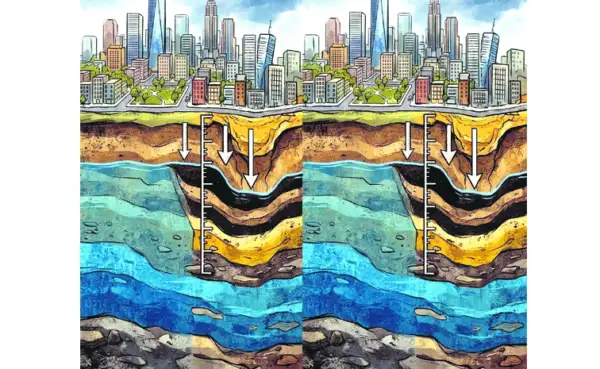
Excessive groundwater extraction is emerging as a serious environmental challenge in several major cities worldwide. The resulting phenomenon, known as land subsidence, occurs when underground water reserves are depleted and the soil layers lose support, causing the land surface to sink. Jakarta in Indonesia, Tianjin in China and several cities in other countries have experienced this problem. In India, studies cited in the report indicate that Kapashera in Delhi is sinking by around 10–17 centimetres annually, while parts of Kolkata are reportedly subsiding by 8–12 millimetres. Satellite-based radar observations are helping scientists monitor subtle changes in the Earth's surface. Hyderabad's IT corridor has shown some signs of minor subsidence, although the report describes the overall risk to Telangana as relatively low because of the region's underlying rock formations. In Andhra Pradesh, the Krishna–Godavari delta and parts of the Visakhapatnam coast may be vulnerable because of their sediment-rich soils and declining groundwater levels.
Research in Osaka, Japan, offers evidence that land subsidence can be slowed and, in some circumstances, partially reversed. Heavy groundwater use between the 1920s and 1960s caused water levels to fall substantially and the land to sink by more than two metres in some areas. After the government introduced stricter groundwater regulations, researchers observed that parts of the city gradually rose as underground water reserves recovered. The study examined monitoring data from 44 wells beginning in 1985 and recorded land-surface recovery of approximately 4 to 12 millimetres per year in some locations. However, the extent of recovery depends on local geological conditions, and some subsidence may be permanent. Experts therefore stress the importance of responsible groundwater use, rainwater harvesting and replenishing aquifers. These measures can reduce the risk of further land sinking and help protect urban infrastructure and vulnerable coastal areas.













Comments (0)
No comments yet
Be the first to comment!