

General


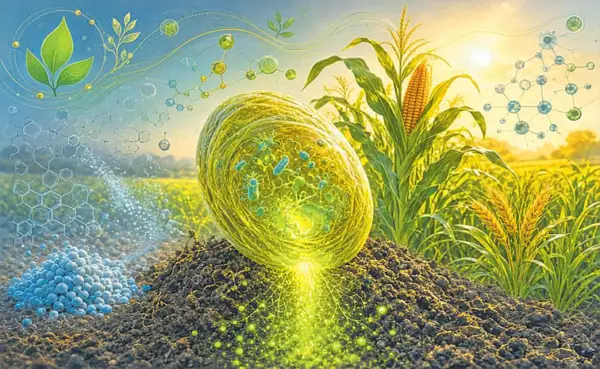
Scientists from the Indian Agricultural Research Institute (IARI), New Delhi, and the National Remote Sensing Centre (NRSC), Hyderabad, have developed a new bio-polymer-based green fertiliser aimed at reducing the environmental impact of agriculture without compromising crop yields. The formulation combines natural materials such as corn starch and mango kernel-based bio-polymers with nano-clay. It also contains urea and microorganisms, including Lactococcus lactis and Pseudomonas aeruginosa. According to the research findings, the formulation can reduce nitrogen fertiliser use by 25% while maintaining crop nutrient availability and supporting yields. The researchers reported that the microorganisms can remain viable in the soil for nearly 180 days and help plants access nutrients such as phosphorus and zinc.
The research was conducted using a maize-wheat cropping system. Compared with conventional urea application, the corn-starch-based formulation reduced nitrous oxide emissions by 28.7% in wheat and 24.2% in maize. The mango-kernel-based formulation recorded reductions of 17.2% in wheat and 21.4% in maize. The bio-polymer mixtures also demonstrated strong water-retention capacity. After 24 hours, one gram of the corn-starch mixture absorbed 68 grams of water, while the mango-kernel mixture absorbed 62 grams. This property could help crops retain moisture during dry spells. However, researchers noted that the effects on carbon dioxide and methane emissions require further assessment and that large-scale field trials across different soil and climatic conditions are necessary before the technology can be widely recommended.
















Comments (0)
No comments yet
Be the first to comment!