
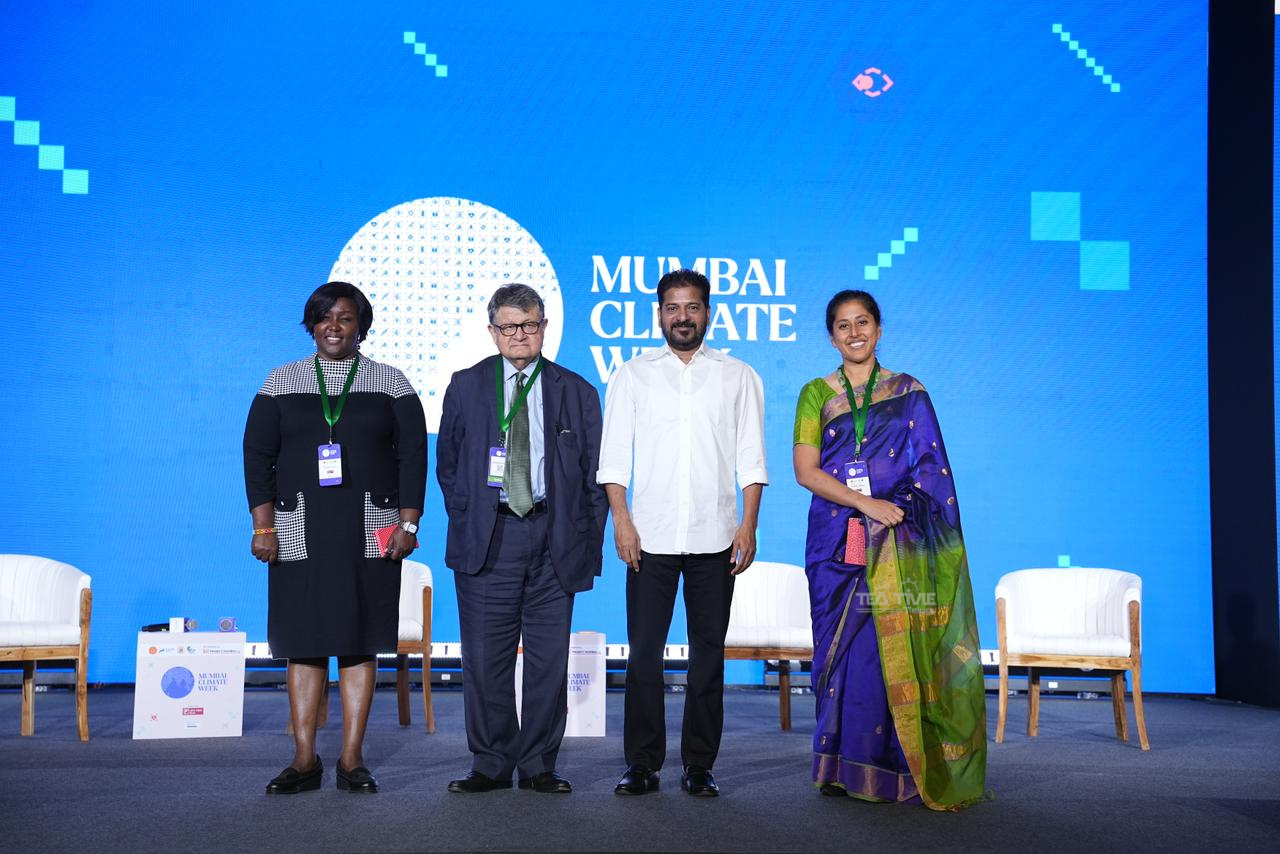
At the ‘Climate Week’ conference held in Mumbai, Telangana Chief Minister A. Revanth Reddy clearly articulated the importance of green energy. He emphasized that renewable energy is crucial for global environmental protection and stated that the Telangana government is giving top priority to clean and sustainable power sources. Currently, the state supplies free electricity to over 3 million pump sets and nearly 5 million households. The government’s key objective is to gradually shift power generation from conventional sources such as coal to solar and other renewable energy sources. He also reaffirmed the commitment to transform Hyderabad into a Net Zero city by 2034 and to make it the first Indian city to undertake a comprehensive carbon footprint audit. Additionally, plans are being designed to ensure that no industries operate within the Core Urban Region (CURE) over the next five years.
Reviewing India’s development journey, the Chief Minister noted that in the decades following 1947, priority was given to education and irrigation. The establishment of prestigious institutions such as IITs, IIMs and IISc, along with the construction of major dams, significantly strengthened agriculture and national growth. After the 1991 liberalization, privatization and globalization (LPG) reforms, India emerged as a strong service-sector economy, supported by telecom and software revolutions that expanded urban infrastructure. However, he observed that the manufacturing sector did not fully capitalize on available opportunities. In the post-COVID era, he stressed that manufacturing, environmental protection and sustainability have become central to development strategies. He underlined that power generation is the true backbone of any economy and reiterated Telangana’s target of becoming a $1 trillion economy by 2034 and a $3 trillion economy by 2047.
The Chief Minister explained that Telangana’s strategic development model divides the state into CURE, PURE and RARE zones. The Core Urban Region Economy (CURE) falls within the Outer Ring Road (ORR), while the area between the ORR and the proposed Regional Ring Road (RRR) is being developed as the PURE zone dedicated to manufacturing. The vision is to build this region into the largest manufacturing hub in the country and position Telangana as a “China +1” alternative. Currently, the state’s average daily power consumption stands at 16,610 MW and it is projected to reach 34,000 MW in the coming years, with nearly 25% already sourced from green energy. Measures such as tax exemptions for electric vehicles, metro rail expansion, introduction of electric buses, retrofitting of auto-rickshaws, rejuvenation of the Musi River, conservation of lakes and the establishment of HYDRA for environmental protection are aimed at transforming Hyderabad into a sustainable, safe and rapidly growing city. He concluded by stating that the ultimate goal is to position Telangana as a model state for the nation.










Comments (0)
No comments yet
Be the first to comment!