
General


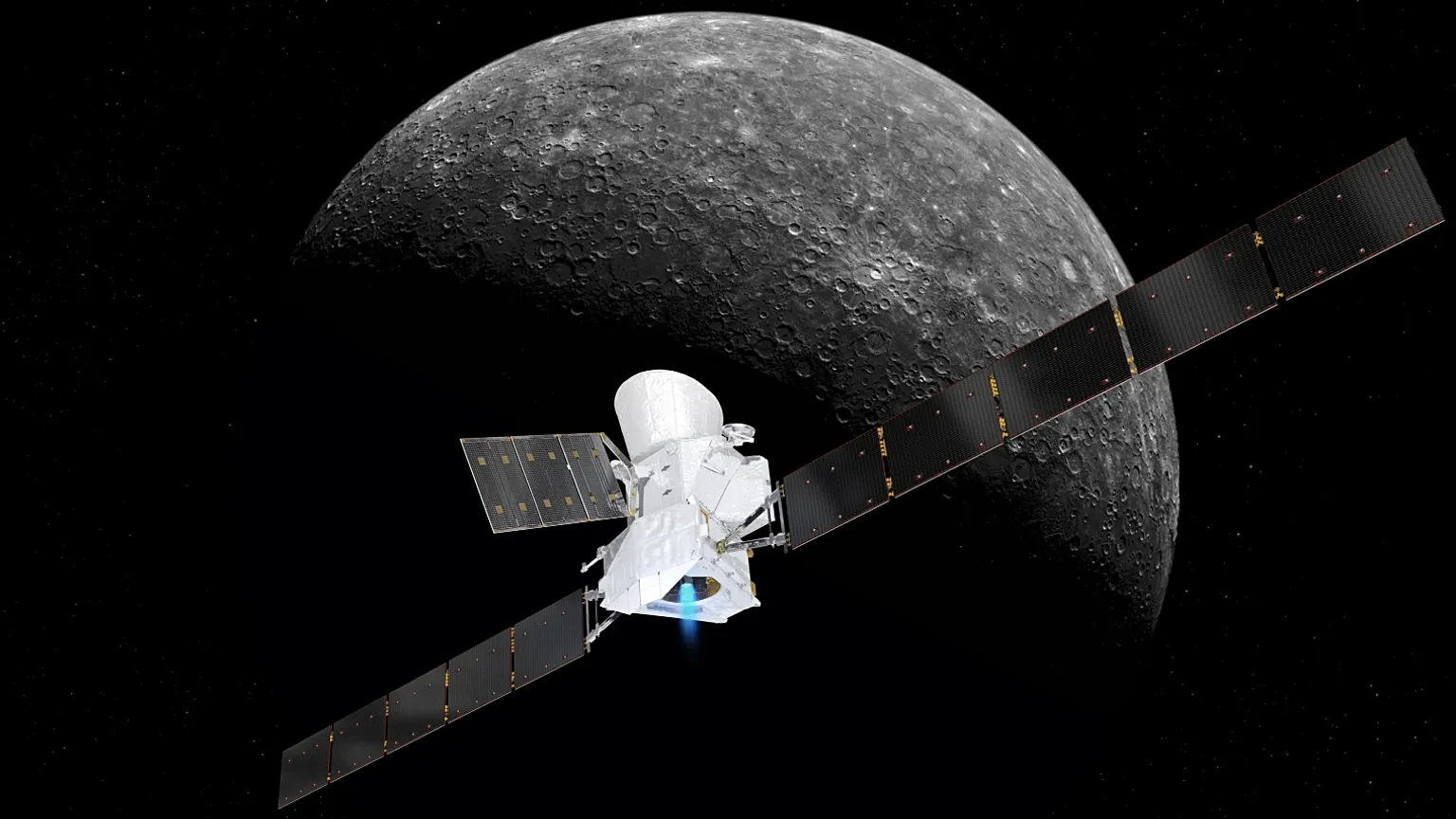
The BepiColombo spacecraft has entered Mercury's orbit following an extended journey through space, marking a significant milestone in planetary exploration. The mission aims to uncover several mysteries surrounding Mercury, the closest planet to the Sun. BepiColombo is a joint mission involving two robotic orbiters, one developed by the European Space Agency and the other by the Japan Aerospace Exploration Agency. The spacecraft are scheduled to separate next month and begin studying the planet from different orbital altitudes. The mission, estimated to cost around $2 billion, achieved the crucial orbital insertion by firing its onboard thrusters on Saturday to reduce its speed and allow Mercury's gravity to capture it. Flight controllers in Germany took several hours to confirm the successful manoeuvre, keeping scientists waiting anxiously.
Launched in 2018, BepiColombo followed a complex route instead of travelling directly to Mercury, using gravitational assistance from Earth, Venus and Mercury to reach its destination. During its journey, the spacecraft covered more than 10 billion kilometres. Its scientific objectives include studying Mercury's internal and external magnetic fields, mountain ranges, impact craters and plains formed by volcanic activity. With surface temperatures reaching up to 427 degrees Celsius, the extreme environment poses significant challenges to the spacecraft's electronic and engineering systems. Scientists expect the orbiters to withstand these conditions and continue their scientific operations for approximately one year. Earlier missions, including NASA's Mariner 10 and MESSENGER spacecraft, also explored Mercury. BepiColombo is expected to provide further insights into the planet's composition, structure and evolution.












Comments (0)
No comments yet
Be the first to comment!