

General


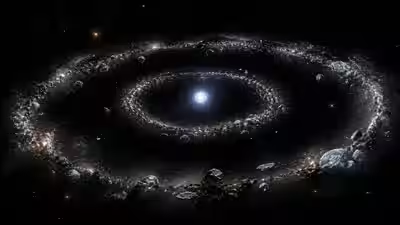
Astronomers have discovered two distinct gas rings surrounding a white dwarf star named J1328-1450, with the rings believed to contain remnants of shattered planets. The star transformed into a white dwarf after shedding its outer layers, leaving behind an extremely dense core. Scientists suspect that some smaller planetary bodies may have survived the destructive transformation and could be responsible for the unusual structures surrounding the dead star. The evidence was identified using the Very Large Telescope operated by the European Southern Observatory in Chile, offering new insights into the fate of planetary systems after their host stars reach the end of their lives.
The discovery also provides clues about the Sun's eventual evolution. In roughly five billion years, the Sun is expected to exhaust its core hydrogen, expand into a red giant and potentially engulf some planets before shedding its outer layers and becoming a white dwarf. Unlike previously observed systems featuring a single debris ring, J1328-1450 appears to have two distinct rings. Although astronomers did not directly observe the rings, their presence was inferred through gravitational effects and interactions with surrounding dust. Small planetary bodies known as planetesimals may be maintaining the separation between the rings. Researchers also detected differences in their composition, with the inner ring containing magnesium emissions while the outer ring showed significantly lower levels, suggesting that the rings could represent different layers of a single disrupted planet or remnants of two separate planetary bodies.

















Comments (0)
No comments yet
Be the first to comment!