

General


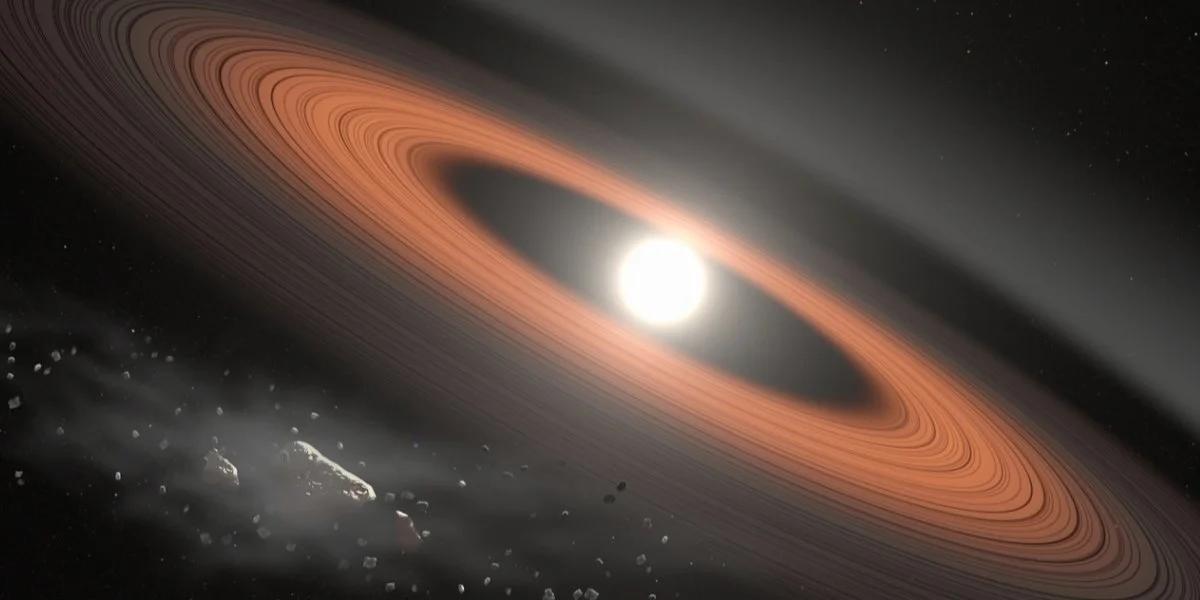
Stars, like living organisms, have a life cycle and eventually reach their end. Our Sun, the centre of the solar system and the primary source of heat and light for Earth, will also meet this fate billions of years from now. Scientists are now studying what happens to planets when their parent stars die. A recently studied dead star, identified as J1328-1450, has offered important clues about this cosmic mystery. The star has evolved into a white dwarf, leaving behind an extremely dense core after shedding its outer layers. Astronomers have detected two distinct rings of gas and debris surrounding it, containing remnants of disrupted planetary material. This discovery suggests that some smaller planetary bodies may survive even after their host star undergoes its final stages of evolution. The unusual structures surrounding the white dwarf could be influenced by the gravitational pull of these surviving planetary remnants.
Scientists explain that the Sun generates energy through nuclear fusion, converting hydrogen into helium. In approximately five billion years, the hydrogen in its core will be exhausted, causing the Sun to expand dramatically into a red giant. During this phase, it could engulf some of the planets in the solar system. Eventually, its outer layers will be expelled, leaving behind a dense central core known as a white dwarf. Unlike previously observed white dwarfs, J1328-1450 appears to have two separate debris rings, one located much farther from the star. Researchers identified these structures using the European Southern Observatory's Very Large Telescope in Chile. Although the rings were not directly observed, their presence was inferred through gravitational effects and interactions with surrounding dust. Scientists suspect that surviving planetesimals, which are solid planetary remnants, may be keeping the rings separate through their gravitational influence. One object could be just a few kilometres across, while another may be comparable in size to Pluto or Earth's Moon. Differences in the chemical composition of the rings, particularly the presence of magnesium in the inner ring and its lower abundance in the outer ring, suggest that the material could have originated from different layers of a planet or from two separate planetary bodies.

















Comments (0)
No comments yet
Be the first to comment!